
Alli-Yums Part 1
Garlic in decasyllabic verse, a toum recipe, and a little food chemistry.

Welcome back to No Manners.
Oh Garlic, to what shall I compare thee?
In temperate climes thou will mostly grow,
But, when thy darling, tasty bulbs are free
Thou shall have the power to make tears flow
-Sam Lopane, 2025
Garlic, leek, onion, shallot, scallion, chive - some of the most scrumptious plants we have been blessed with. This newsletter kicks off my series on alliums (more like alli-YUMs) – the plant genus that encompasses all of these delicious vegetables. We’re going to start with GARLIC, which is certainly one of the most beloved of alliums. To showcase the power of garlic, down below I’m including my recipe for a variation of TOUM - a garlic sauce, Lebanese in origin, that is unafraid of the pungent potency of garlic.
Allicin
Future newsletters will dive into the anthropological, and agricultural origins of these vegetables, but today we’re going to start with some of the food science. To me, it’s impossible to begin a discussion of garlic without thinking of the spicy pungency of garlic. That piquant punch is caused by allicin, a sulfur-containing compound that sends a burning sensation to our brain by activating certain sensory neurons in our mouth, similar to capsaicin from peppers. However, before being cut or chopped, garlic doesn’t actually contain allicin – it has a precursor molecule called alliin that is relatively tame, and an enzyme called alliinase. The enzyme is what converts alliin to allicin. (Fun fact - the garlic plant makes these sulfurous compounds as a defense mechanism to ward off pests!) Under normal conditions, the allinase is stored in one part of the plant cell (the vacuole) and the alliin is in another (the cytoplasm). Imagine if the alliin is hanging out in the living room of a house and the alliinase is stuffed in the closet. However, as soon as garlic is chopped, crushed, or grated, the plant cells have been physically torn apart, and the allinase is free to immediately begin converting the allin to the spicy form of allicin. In our house analogy, it’s as if chopping, grating or slicing causes the walls of the house to get torn down and the alliinase can now party with the alliin.
This is actually why grated garlic is spicier than sliced or minced – the more you break down the walls, the more alliinase can get to work.
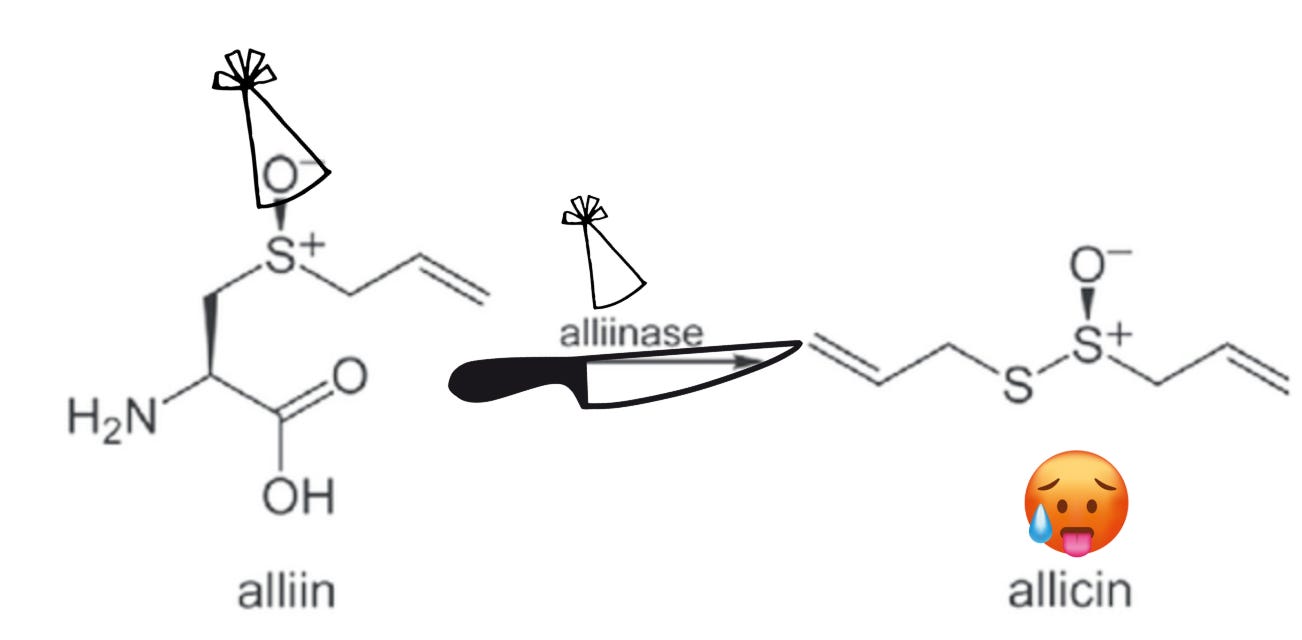
Depending on the application, this spiciness can be a welcome addition to a dish. However, in a sauce like toum, which is primarily garlic, too much allicin can be overpowering and be incredibly spicy. Fortunately, there are plenty of ways to prevent allinase from getting too busy with the alliin. Alliinase, like all enzymes has a pH range that it’s functional in, meaning it can be deactivated in low pH (acidic environments), and we already have an acid in the sauce – lemon juice! By controlling the timing of the addition of the lemon juice we can control how spicy the sauce is. Simply adding the lemon juice right after the garlic is chopped, and letting it briefly sit will help slow the formation of the allicin, and make for a delicious sauce that you can eat even more of.
However, garlic is more than just allicin. Part of the reason garlic is added to many vinaigrettes, in addition to flavor, is also emulsification. Toum is a fascinating sauce because it contains SO MUCH GARLIC, and gets SO DAMN FLUFFY. Some of the other components of garlic are what help emulsify this sauce - they keep the oil droplets spread out among the water droplets and not coalesced together. First, there’s sugars and fibers etc that thicken the water in the sauce, and slow things down from separating, and in addition to that there’s these molecules called saponins, which are generally both water and fat soluble - making them the perfect bridge molecule that will keep your toum fluffy, even, and emulsified.
Toum Recipe
Ok, that’s enough science for now – go make this recipe!
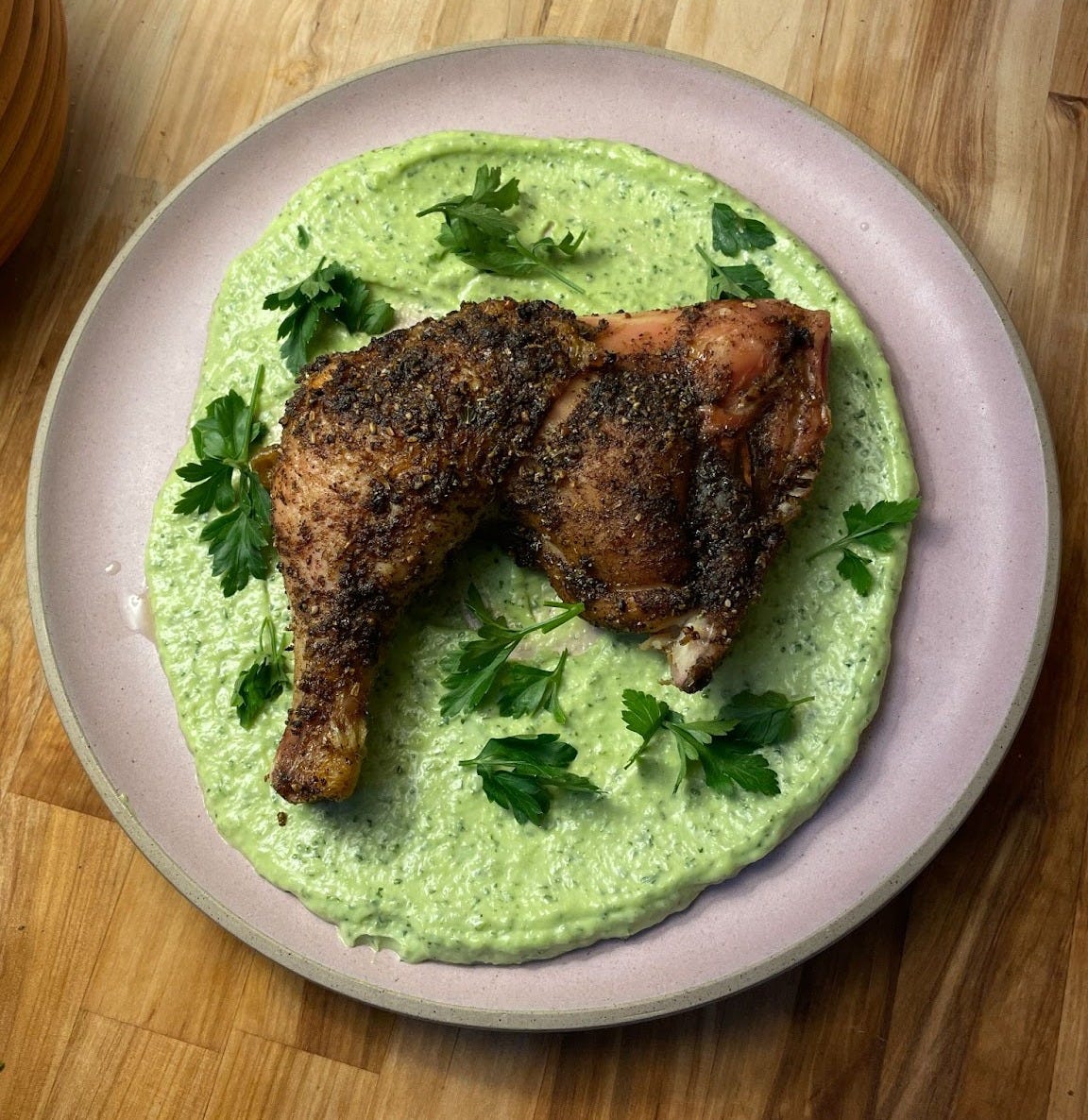
This green toum is the perfect condiment to slather on roast chicken, stuff into a pita, dress a sandwich, or even just use as a dip. If you want plain toum rather than green… just omit the parsley Enjoy!!
For Green Toum
~1/3 cup garlic cloves (70g)
2 teaspoons kosher salt
1/4 cup (85g) fresh lemon juice from about 1.5 lemons, divided
1/8 cup (30g) ice water
2 cups (400g) neutral oil, such as grapeseed
1/2 bunch parsley
DIRECTIONS
Add garlic to a food processor (alternatively, you can use a blender or immersion blender or mortar and pestle). Pulse for 30 seconds, then immediately add the lemon juice and let sit for 5 minutes.
After 5 minutes, run food processor until a puree of garlic and lemon juice has formed. With the blade running, slowly drizzle in half the oil, then the ice water, then the oil, pouring very slowly to ensure emulsion doesn’t break.
Once toum looks fluffy and emulsified, add parsley and pulse until broken down.
Enjoy! Slather on chicken, fish, lamb, bread, anything you like!
As we stumble our way through the final gasps of Winter, I’d like to share a poem by the ever-luminescent Wendell Berry. I’ve recently been enjoying a new release of a collection of his poetry, Another Day, and I hope it brings you as much presence as it brought me.
Here is the first fact
of the history of spring: you cannot
remember it as you go about
your chores in the winter cold,
the world and its informing
life dead in your heart,
or imagine it as it will be
when it comes fully into living
presence in light and warmth.
From nothing to lavender phlox
afloat in the air, to the leafing
oak, to the yellowthroat: the ancient
miracle realizes itself
again. The most factual
denier must think of nothing
before these somethings can appear.
Where the winter lay dead-brown
on the woods floor, now green
leaves and flowers open
and flourish in unconditional being,
recalling nothing, expecting
nothing, nothing guaranteed.
Like the flowers, I too
must live on without condition,
expecting nothing but to be
present in the passing day.
–Wendell Berry, “Here is the first fact”, 2013.
Until next time. Peace!
Sam
Sources
Damodaran, S., Parkin, K. L., & Fennema, O. R. (2008). Fennema’s food chemistry (4th ed). CRC Press/Taylor & Francis.
Macpherson, L. J., Geierstanger, B. H., Viswanath, V., Bandell, M., Eid, S. R., Hwang, S., & Patapoutian, A. (2005). The pungency of garlic: activation of TRPA1 and TRPV1 in response to allicin. Current Biology, 15(10), 929-934.
Suvarna, Y., & Rajagopalan, R. (2015). Garlic: Nature’s panacea. Asian J Pharm Clin Res, 8(3), 8-13.
Berry, W. (2024) Another Day. Counterpoint Press.
So here for the alli-yum series